
Meet Your New AI-Powered Exercise Chatbot
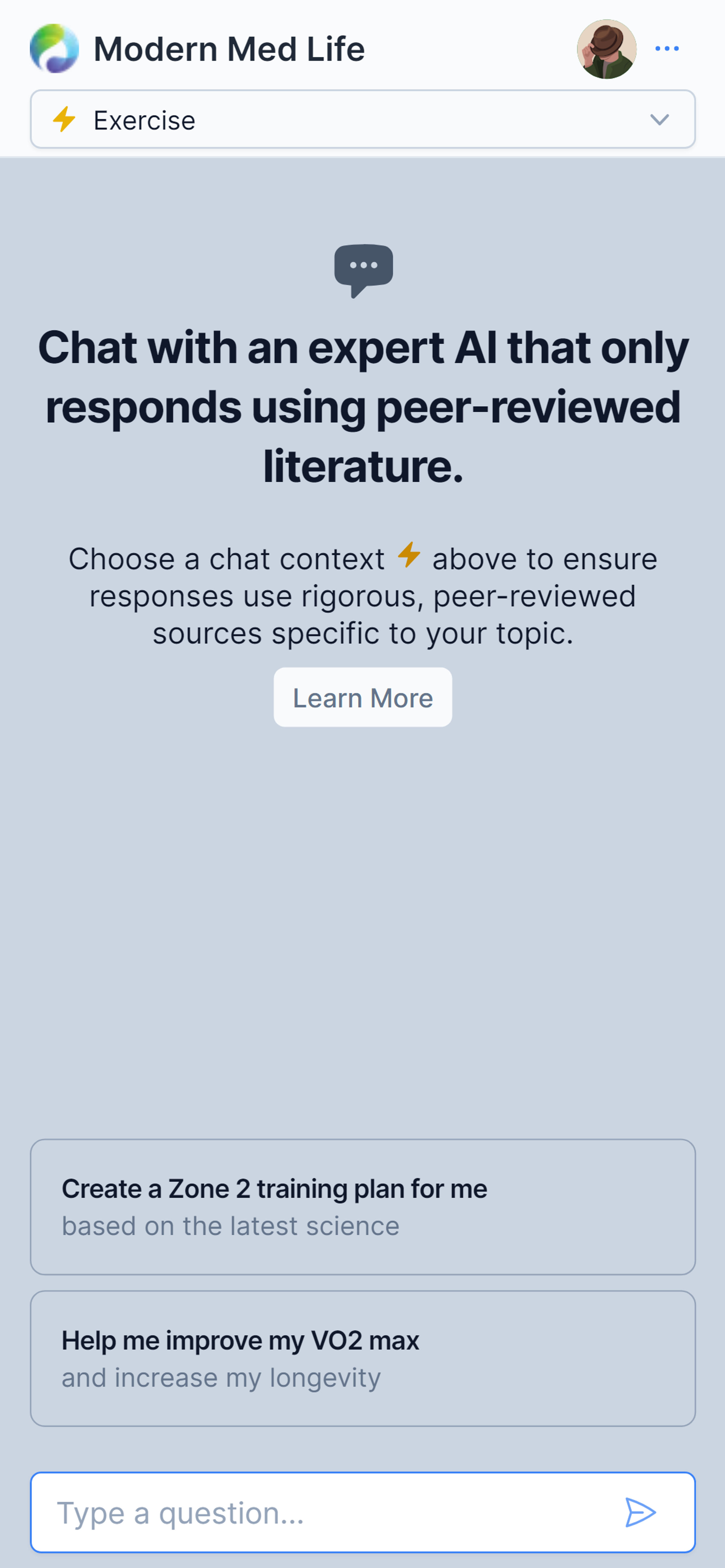
Inspired by Dr. Peter Attia's longevity research in "Outlive," we are excited to introduce our new AI Longevity Assistant designed to provide cutting-edge insights into optimizing your healthspan.
About the AI Longevity Assistant
Doctors rely on the same evidence-based sources as the AI Longevity Assistant, like JAMA and The New England Journal of Medicine. Think of the AI Longevity Assistant as an expert medical librarian, providing fast access to trustworthy studies and summaries tailored to your unique questions and interests.
Precision and Trust: How Our AI Ensures Factual Responses
Ensuring the AI Longevity Assistant only provides accurate information is crucial. This is achieved through document retrieval—it only scans esteemed medical journals to generate responses, significantly reducing the chance of inaccurate "hallucinations."
A Powerful Educational Supplement, Not a Replacement
Recent research indicates that AI Longevity Assistants can provide thoughtful, empathetic responses from evidence-based and peer-reviewed medical sources. The AI Longevity Assistant's role is to educate and inform, not diagnose or prescribe treatment.
For example, a study published in JAMA found that in over 78% of cases, medical professionals preferred AI-generated answers to physician responses for quality and empathy (Shen et al., 2022).
Disclaimer
The AI Longevity Assistant is a game-changing supplement for your health education journey, however, is not a doctor and cannot provide individual medical advice. It serves as a powerful supplement to help you get educated on health topics, allowing you to be more proactive in your longevity and health.
Give it a try
Your Suggestions
Let us know if you have any other suggestions for how the AI Longevity Assistant can best support your learning! Here's to healthier, longer lives.
References
Shen, M. J., Livermore, J. W., Kamath, A. F., Gawande, A. A., & Walker, D. M. (2022). Comparing Physician and Artificial Intelligence Chatbot Responses to Patient Questions Posted to a Public Social Media Forum. JAMA internal medicine, 182(4), 460-466.